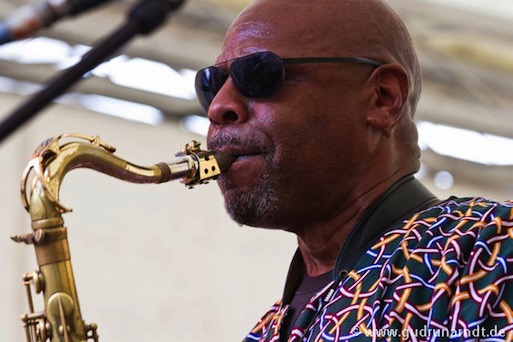
Fuasi Abdul-Khaliq Fuasi Abdul-Khaliq

Fuasi Abdul-Khaliq

Lifelight Productions & Publications

Fuasi Abdul-Khaliq

Gudrun Fuasi
Band leader, Arranger, Composer, Producer, Educator

“In order to trace back the musical career of the Los Angeles born saxophonist, composer and arranger, Fuasi Abdul-Khaliq, you would have to dig back into his early childhood: at the age of six, he began singing in the church choir and for his 8th birthday, his mother gave him a clarinet which he learned how to play from Milton Hall, a professional musician and teacher, in his neighborhood. Throughout his early years, his musical talent was already evident in the number of competition awards he won in elementary school and junior high bands he played including two LP Albums he recorded at the age of 10 and 11 as 1st clarinetist in the Los Angeles Unified All City Elementary School Honor Orchestra.Despite his dreams of becoming a professional musician, Fuasi left Los Angeles and went to Washington State where he started his studies. In the following four years, he studied Sociology and Music at Whitman College, in Walla Walla, Washington. He studied saxophone (self taught) and was instrumental in organizing and bringing several famous jazz recording artists such as Sam Rivers, Jimmy Garrison, Sonny King, Bill Cole, Nathan Davis, Edward Blackwell, Clifford Thornton, Joe Brazil and Dave Burrell to the campus of Whitman College where he organized and attended a series of workshops they conducted over a two week period. At that point, Fuasi ultimately decided to fulfill his dream to become a professional jazz musician". To get more insight into his transition from Whitman College to the beginning of his professional career with Horace Tapscott and his Pan-Afrikan People's Arkestra, you can read excerpts from the book "The Dark Tree" by Steven Louis Isoardi.Fuasi has been performing professionally since 1972 after graduating from college while during his post graduate studies with the late great African-American pianist, Horace Tapscott and his non-profit institution named UGMAA (Union of God's Musicians and Artist Ascension) in Los Angeles, California. This led to a lifetime relationship with Tapscott's Pan-African People's Arkestra (PAPA), during which time he served as assistant conductor, arranger, composer, copyist and player of saxophone, clarinet and flute. He has performed from coast to coast in the U.S. and in 1992 he came to Berlin where he became well known in the city's music scene. During the last 20 years abroad in Europe, Asia, Africa and Central America, he has led his own ensemble as well as sharing the stage with such greats as Walter Bishop Jr., Jimmy Garrison, Charles Owens, Jeff Littleton, Rudy Stevenson, Ed Blackwell, Arthur Blythe, Queen Negus H. Somayah Moore-Kambui and the Black Belt Symphony, Arto Tuncboyaciyan, Danny Harper, Joe Jennings, Joe Bowie, Hal Singer, Sugar Blue, Nedra Wheeler, Abdu Salim, Dick de Graaf, Abraham Burton, Omar Sosa, Kelvin Sholar and Winard Harper to name a few.In 2006 Fuasi created a new group called "The Horace Tapscott Memorial Ensemble." They perform compositions and arrangements from his late teacher and mentor, Mr. Horace Tapscott. Mr. Tapscott was a musician, community activist and a folk hero in Los Angeles who dedicated his life to creating, archiving, performing, preserving and disseminating the music of the African-American musical community of Los Angeles California so that the generations afterwards would know and benefit from the contributions that they have made as the artistic members of this community. Horace founded "Union of God's Musicians and Artist Ascension" (U.G.M.A.A.) and the "Pan African Peoples Arkestra" (P.A.P.A.) in 1961 which Fuasi has been a member since 1973. Many famous and well known international musicians have been (and still) involved with Horace and his organization which included Azar Lawrence, David Murray, Pharoah Sanders, Butch Morris and Arthur Blythe. There are 2 books published about Horace and his contributions; "Songs of the Unsung" and "The Dark Tree"; by Steven Louis Isoardi.